Angkor Wat Gate of Angkor Thom Sunset at Angkor Wat Kai Island, Phuket Hong Kong Bangkok City Floating Market, Bangkok
Showing posts with label Malaysia. Show all posts

Sunday, March 6, 2016

Unknown

Wat Chaiya Mangkalaram Temple in Penang


Wat Chaiya Mangkalaram Temple is the largest Thai temple in Penang. Set just off Jalan Burma (on the way to Batu Ferringhi), the yellow-and-blue temple is also known as Wat Buppharam. Built in 1845, it is home to a 108ft-long reclining Buddha image, said to be the third largest in the world.

Draped in a gold-leafed saffron robe, the sprawling statue was erected as a monument to signify Buddha’s final resting position at his death and symbolizes his detachment from worldly matters. Located opposite the less extravagant Dharmmikarama Temple (which lights up beautifully at night) Wat Chaiya Mangakalaram Temple is a beautiful sight with ornate, gold pagodas, and mural-painted walls.

Spread across five acres of land (which was gifted by Queen Victoria to the Thai community as a gesture of goodwill to bolster trading relations with Thailand) Wat Chaiya Mangkalaram Temple was originally led by a Thai Theravada Buddhist monk, Phortan Kuat. 

Also known as the ‘Powerful Monk’, he was very much adored by his congregation: to this day, his devotees bring bowls of asam laksa (coconut-based sour gravy noodles) to his shrine to honor him.

Wat Chaiya Mangkalaram Temple is designed in typical Thai-style with sharp-eaved roofs and flamboyant ceilings. The temple entrance is set off by a statue of a naga (a Southeast Asian water dragon), while the exit is marked by a Chinese dragon (the East Asian equivalent). 

These serpents lay coiled around the feet of two grim green-faced statues carrying hefty swords that flank the entryway: supposedly the statues were designed to ward off unwanted visitors.

The reclining Buddha statue at Wat Chaiya Mangkalaram Temple is surrounded by elaborate images of a gold-leaf covered Buddha in different poses. Each pose is supposed to signify different things: Buddhists believe that the reclining Buddha, for example, (with his head resting in the palm of the right hand and his head pointing northwards) signifies enlightenment or Nirvana.

Around the outstretched giant Buddha sculpture are a series of hand-painted gold 3D images detailing Gautama Buddha’s story. Interesting fact: underneath the lounging Buddha are slots where urns containing the ashes of deceased devotees are stored.

In addition to the 108ft-long reclining Buddha, Wat Chaiya Mangkalaram Temple also has smaller statues of the ‘Awakened One’ in various guises plus you can also see statuettes of other popular Thai deities in the main prayer hall. Besides that there is a series of colourful statues of Devas and other mythical creatures on display, spread out across the temple grounds. Vibrant murals depicting Buddha’s life story are painted on the temple walls. Wat Chaiya Mangkalaram Temple is open between sunrise and sunset and entrance is free.

During traditional Buddhist festivals like Songkran and Loy Krathong, local Thais crowd the temple for the celebration since the temple acts as the focal point for the event.

Wat Chaiya Mangkalaram Temple
Opening Hours: 10:00 – 18:00 Daily
Location: Lorong Burma, Pulau Tikus, Georgetown

Read More
Unknown

Penang Khoo Kongsi


Khoo Kongsi is one of Georgetown’s most interesting attractions. Built some 650 years ago, it is part of the goh tai seh (five big clans) that formed the backbone of the Hokkien community in olden-days Penang. One of Penang’s most lavishly decorated kongsis, it is located on Jalan Acheh, off Lebuh Pitt.

A kongsi (clan house) is a building in which Chinese families of the same surname gather to worship their ancestors. Representing a family’s social and spiritual commitments between extended relations, ancestors and the outside community, the kongsi also acts as an important means of solidarity. These days the primary functions of kongsis are supportive roles: they help with the educations of members’ children, settle disputes and advance loans.

The kongsis were initially developed as a way for 19th-century immigrants to band together according to their respective districts. Unsurprisingly, as a result of this clan-centric bias, hostile sentiments developed between the different clan houses resulting in rivalry and eventually violence. 

Many of the kongsis in Penang are more than 100 years old; the Khoo Kongsi, once known as one of the most prominent Chinese lineages in Malaysia, is probably the most famous clan house in Penang. Founded by the Leong San Tong clan from the Sin Kang clan village in Hokkien Province, the clan house was built primarily to showcase the success of the Khoo family.

Khoo Kongsi remains till this day an impressive architectural feat that exemplifies good luck and prosperity. The other big clans during the time of its inception were the Cheah, Yeoh, Lim and Tan families who also have clan houses erected to act as a central point of their respective communities. However none were as magnificent as the Leong San Tong (Khoo Kongsi) which was said to be the most impressive in Southeast Asia.

At the height of the Khoo family’s prominence, craftsmen from China were commissioned to build this architectural masterpiece. Also known as Dragon Mountain Hall, Khoo Kongsi is an ornate structure standing on a square of granite with stone carvings that adorn the entrance hall. 

Additionally, there are pavilions, murals portraying birthdays, weddings and 36 divine guardian-statues sprinkled throughout its interior. Meanwhile, massive overhead paper lamps bathe the interior in an orange glow and stunning ceramic sculptures of immortals, carp fish and dragons line the roof ridges.

Opening Hours: 09:00 – 17:00
Address: 18 Cannon Square, Georgetown
Tel: +604 261 4609
Read More
Unknown

Penang Fort Cornwallis


Fort Cornwallis is the largest standing fort in Malaysia. Set close to the Esplanade and Penang Clocktower, the star-shaped bastion is one of the oldest structures in Penang. Named after Marquis Charles Cornwallis, only a set of ten-foot high outer walls remain, with an enclosed park within.

Situated on Penang’s north-eastern coast, a stroll along the privately-managed Fort Cornwallis’ perimeters will take you about 10 minutes. It is a surreal experience to hear the 1812 Overture playing over the speaker system while a Malaysian man dressed in full British regalia stands at the gate. Inside the fort is a variety of vaguely-informative exhibits.

Built in 1786, Fort Cornwallis was intended as a defensive structure against pirates, Kedah forces and even the French during the Napoleonic Wars. However although it was initially built for the Royal artillery troops and the military, it served an administrative function rather than an actively defensive one. 

Spanning 4490sqft it was built as a stockade with no permanent structures. The fort stands on the site where Captain Francis Light first set foot in 1786 on the then virtually-uninhabited Penang and took possession of the island from the Sultan of Kedah. He then established a free port to lure trade from Britain’s Dutch rivals.

Originally built of bong palms, during Colonel R.T. Farquhar’s term as Governor of Penang Fort Cornwallis was rebuilt with bricks and stones using Indian convict labor thus transforming the wooden fort into a stone structure. 

Fort Cornwallis’ star shape is attributed to the fact that this design was a better defense against multiple fields of fire from enemies.

A bronze statue of Captain Francis Light stands near Fort Cornwallis’ main entrance. Inside the fort are prison cells, barracks, munitions storage areas, a harbour light once used to signal incoming ships and the original flagstaff. 

At the southwest corner of the fort is Penang’s first chapel, built in 1799. You can also see several old bronze cannons inside the fort including Seri Rambai, which is popularly regarded as a fertility symbol. Locals often place offerings of flowers and toss sticks at its base.

Opening Hours: 09:00 – 18:30 Daily
Location: Lebuh Light
Tel: +602 61 0262


Read More
Unknown

Penang War Museum


Penang War Museum in Bukit Batu Maung was a fort built by the British in the 1930s. In 1941 it gained fame when it became the site where the battle for Penang against the invading Japanese army was lost. These days it is a museum open to the public and is billed as Southeast Asia’s largest war museum.

Situated on the road to Teluk Kumbar on Penang’s southern coast, the fort was initially supposed to be a preserved citadel constructed as part of a plan to protect the island from foreign invasion. It is also known as Muzium Perang Pulau Pinang.

The former British bastion was manned by British, Sikh and Malay soldiers after its completion. It fell during WWII when the Japanese launched an attack against the fort from inland, rather than from the sea, as was expected by the British. 

From that day onward (17 December 1941) the Japanese commandeered the stronghold and the army base became chequered with a dark past. It was used as a prison base for acts of torture and other cruelties; as a result of these war atrocities, the garrison was dubbed ‘Bukit Hantu’ (Ghost Hill) by locals due to the hundreds of people who were brought here and beheaded.

The Penang War Museum was restored as a memorial to its dark days and opened to the public in 2002. Interesting fact: the 20-acre museum houses historical artifacts such as cannons and even features underground military tunnels and ammunition bunkers which are located nine meters underground. Some of these tunnels lead all the way to the sea as they once served as access routes to get to submarines. Navigating through these passageways sometimes forces one to walk or even crawl through very narrow, confined spaces. 

Additionally, you can also tour the barracks, cookhouses, gun emplacements and other structures in the eerie and vast Penang War Museum as there are plenty of signposts to guide your way.

Opening Hours: 09:00 – 19:00
Address: Lot 1350 Mukim 12, Daerah Barat Daya, Batu Maung
Tel: +604 626 5142 or +6016 421 3606
Read More
Unknown

Escape Adventureplay


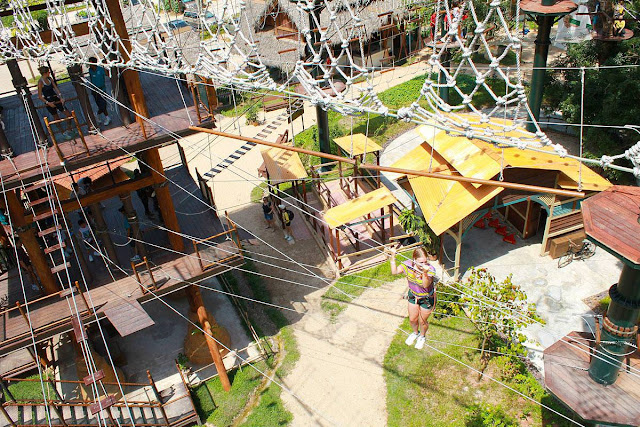
Escape Adventureplay Penang is a cool alternative to the beach and has quickly turned into a firm favorite with outdoor adventure seekers on the island. An outdoor, eco-conscious theme park specializing in zip-lining (a pulley suspended on a stainless steel cable, tied between two trees on an incline), the park also hosts other fun jungle activities for all ages. 

A creative and fun way to foster a love of the outdoors, especially among kids, the park started out in 2012 with standout attractions such as a free fall from a 20 meter-high jump platform, an inner tube slide and tree rope swing.

Free Fall & Zip Lining
There are quite a few thrill rides to try here. We love the Atan’s Leap, a gravity-defying free fall activity that will see you taking the plunge from a 20 metre-high platform. You will fall through the air and land safely onto an absolutely-safe, extremely large, inflated feathered on the ground; for safety purposes, this activity is limited to those aged 13 years old and above. Another attempt to push the laws of physics at Escape Adventureplay Penang is the Flying Lemur, an obstacle course that will have you climbing 98 feet off the ground. To reach the finish line, you will have to overcome hurdles that will include the region’s longest zip line (456 feet-long) across a ravine. The thrilling final obstacle will have your adrenaline levels peaking!

Tree Swings & Water Park
Intent on providing a variety of activities for all ages and courage levels, Escape Adventureplay Penang is also home to rope swings, set at different inclinations, allowing those who are more adventurous to swing from higher heights, while beginners can feel safe swinging from lower elevations. Besides that, the park also has places where you can play on balance beams, engage in tree climbing contests, navigate through a fun but wobbly rope course, and even go exploring through a cave! In addition to all that is already available at Escape Adventureplay, there are plans to add in a water theme park in the quest for bigger and better thrills. Entrance is RM60 for adults and RM45 for kids; open from Tuesday to Sunday, the park also operates on Monday when it is a public or school holiday. There is a free hourly shuttle service from a couple of Jalan Batu Ferringhi hotels, or from Georgetown guests can hop on the Rapid Penang bus 101.

Opening Hours: 09:00 – 18:00 Tuesday – Sunday
Address: 828 Jalan Teluk Bahang, 11050 Penang
Tel: +604 881 1106


Read More
Unknown

Cheong Fatt Tze Mansion in Penang


Cheong Fatt Tze Mansion, a boutique hotel that’s one of Penang’s best-known attractions in an ornate edifice built in the traditional Hakka – Teochew style. Located at 14 Leith Street, the structure was erected in the 1880s when Hakka merchant, Cheong Fatt Tze commissioned its construction.

A self-made and affluent merchant-trader, Cheong Fatt Tze left China as a penniless teenager but soon rose to the ranks of the well-heeled when he established a vast financial empire throughout East Asia at the end of 19th century. Despite the popularity of modern Anglo-Indian designs at the time, he chose to build his domicile as a traditional-style Chinese courtyard house. The stately manor has 38 rooms, five granite-paved courtyards, seven staircases and 220 timber-frame windows.

Rescued from ruin in the 1990s, the indigo-blue mansion blends elements of Eastern and Western design and stands apart from other structures along the street due to its distinctively gregarious exterior. Featuring art nouveau stained glass and beautiful floor tiles, the mansion is a beautiful representation of the architectural style preferred by wealthy Straits Chinese of the time.

In 1989 the mansion was purchased from Cheong Fatt Tze's descendants in order to save the structure from imminent development that would have resulted in its demolition. Maintained as a private residence, the property also operates as a 16-room bed-and-breakfast as part of an ongoing restoration project; additionally the estate also doubles as a museum. You can choose to visit the mansion on a one-hour guided tour or you can spend the night at the boutique hotel.

Highlighted in various TV programs on networks such as CNN, BBC, The History Channel and Discovery Travel & Living, Cheong Fatt Tze Mansion has also been featured in various films ranging from the 1993 Oscar-winning French film Indochine to the critically-acclaimed 2009 motion picture The Blue Mansion.

Winner of the 1995 Malaysian National Architectural Award for Conservation, the 2000 UNESCO Most Excellent' Heritage Conservation Award, ‘Best Tourist Attraction 2003’ Merit Award by the Malaysian Ministry of Culture, Arts & Tourism and the 2008 Best of Malaysia Travel Award’s ‘Best Boutique Hotel’ by Expatriate Lifestyle magazine, Cheong Fatt Tze Mansion is undoubtedly one of Penang’s most prominent attractions.

Address: 14, Leith Street, 10200 Penang
Tel: +604 262 0006
Read More
Unknown

Kek Lok Si Temple in Penang


Standing on a hilltop at Air Itam, near Penang Hill, Kek Lok Si is the largest Buddhist temple in Malaysia. The complex is divided into three zones while the temple grounds comprise the hill entrance, souvenir, food and drinks stalls and the turtle liberation pond. The mid section of the temple houses temples, gardens, the pagoda and the four heavenly kings pavilion; meanwhile the hilltop plays host to an enormous statue of the Goddess of Mercy, Kuan Yin as well as more gardens and temples.

Comprising a series of monasteries, prayer halls, temples and beautifully-landscaped gardens, this national icon was built in 1890 by Beow Lean, a devout immigrant Chinese Buddhist. The ten-acre site was purchased in 1893 and the initial temple structure was built on the summit of He Shan. 20 years later, the two-decade long additional construction of this sprawling house of worship is largely funded by donations from the Penang Straits Chinese community.

The complex is a cornerstone of the Malaysian Chinese community. Also known as the ‘Temple of Supreme Bliss’, it features a maze of souvenir kiosks as well as a turtle and fish pond. The turtle pond – known as The Liberation Pond – was built because according to Chinese tradition, turtles symbolize longevity, strength and endurance and the act of capturing and freeing a turtle is a symbol of spiritual liberation.

Kek Lok Si is both carved into the rock face as well as perched atop the slopes of Air Itam. The main attraction here is the impressive pagoda of Rama VI and at the centre of the complex, the seven-storey, 30-metre high tower is acknowledged as the ‘face’ of Kek Lok Si. Topped with a Burmese crown, Ban Po Thar – the Ten Thousand Buddhas Pagoda – displays a collection of alabaster and bronze Buddhas and has a Chinese octagonal base while its middle tiers are of Thai design. Meanwhile sited in the Hall of the Devas, are statues of the Four Heavenly Kings – each of the Kings allegedly controls one of the four points of the compasses – Kwang Mu (Guardian of the West), Tou Wen (Guardian of the North), Ch'i Kuo (Guardian of the East) and lastly Tseg Chang (Guardian of the South).

Additionally, there’s a three-storey shrine with a large Buddha icon that was donated by King Bhumibol of Thailand – you can find several temples here as well as shops and a vegetarian restaurant. At the highest level there is a 36.5 meter-high bronze statue of Kuan Yin, the Goddess of Mercy; in the future 16 ornately decorated bronze columns supporting a roof over the statue, as well 1000 two-meter high statues of the goddess are planned to be built.

At the apex are a couple more temples, a fish pond, sprawling gardens and 12 animal statues that represent the Chinese zodiac. Kek Lok Si temple houses tablets and imperial Buddhist sutras gifted by Manchu Emperor Kwang Xi and Empress Cixi of the Ching Dynasty; these historic relics are kept in the temple archives. The impressive complex is usually crowded with visitors and is located approximately three kilometers from Penang Hill.

Location: Air Itam, Georgetown
Tel: +604 828 3317
Price Range: Entrance: Pagoda - RM2; Incline lift - RM2
Read More
Unknown

Penang Hill


Penang Hill was the first colonial hill station developed in Peninsular Malaysia. Comprising Western Hill, Bukit Laksamana, Tiger Hill, Flagstaff Hill and Government Hill, it is located six km away from Georgetown. The hilly and forested area is the state's primary hill resort.

Set 821 meters above Penang’s capital, islanders call it Bukit Bendera and it is generally about five degrees cooler than Georgetown. It is the last patch of tropical rain forest in Penang so the flora and fauna here have been protected since 1960. It does not have the same prominence as Genting Highlands, Fraser’s Hill or Cameron Highlands but it is one of Penang’s best-known tourist attractions due to its fresher climate.

Penang Hill was discovered when soon after British settlement; Francis Light commissioned the area to be cleared to grow strawberries. Though it was never fully developed (it was difficult to carve out the forest area), it became a favorite expatriate refuge before the advent of air conditioning. Its oldest bungalow, Bel Retiro, is the holiday residence of the Governor of Penang. Today, the ridge on top of Penang Hill is known as Strawberry Hill.

From the top of Penang Hill on a clear day you can see the mountains of Langkawi and north Kedah but it is the night time sight of lit-up Georgetown that is especially rewarding. Most people simply come to enjoy the cool, unpolluted air and walk under 30m-high trees along the nature trails. Additionally, over 100 species of bird life, ranging from ordinary garden species to exotic deep forest inhabitants, call this hillside home. 

Two kilometers away from Bellevue Hotel is the Canopy Walk: this 220m walkway suspended between towering trees 30m above the dense jungle offers great views of the hillside. Opened in 2003, it was operational for a short time, and since then, due to its failure to attract sufficient customers, it has opened and closed without much announcement.

The most popular way to the top of the hill is the Penang Hill Railway. Located at the foot of the hill, this Swiss-designed funicular starts out from Air Itam. Built in 1923, it is one of the world’s oldest funicular systems and has a 2,007m-long track that climbs the hill at a crawling 30-minute pace. 

The journey takes you past luxuriant greenery and the occasional macaque plus the bungalows originally built for British officials and other wealthy citizens. The queue for carriages can be quite long especially on weekends and public holidays: passengers have to change trains midway.

Another way to the top of Penang Hill is by a five km drive up a private road accessible only to the vehicles of hillside residents: this jeep trail is a popular hiking route and starts out from the quarry at the entry of the Penang Botanic Gardens. 

There is a well-marked eight km path leading up from the Moon Gate (between the post office and police station) at the Botanical Gardens: it is a steep one-hour climb, but a delightful walk with plenty of places to rest along the way. 

There is a food court, fruit and souvenir stalls, some gardens, an exuberantly decorated Hindu temple, a mosque, a police station, a post office and an 11-room hotel (Bellevue Hotel) at the upper funicular station: the original funicular train, built in 1897, is also on exhibit here.


Read More

Thursday, February 25, 2016

Unknown

Langkawi Underwater World


Spread across nearly six acres, Underwater World Langkawi is one of the island’s best-known attractions. Located at the southern end of Pantai Cenang (almost at the border of Pantai Tengah), beside the Zon duty-free shopping center, it is Malaysia’s largest aquarium. The huge white-washed structure houses more than 200 different species of marine and freshwater fish including harbour seals, rock hopper penguins, sharks, giant rays and the enormous Amazonian arapaima – the biggest freshwater fish in the world. Once you enter the air-conditioned interior, Araipamas (the world's largest freshwater fish) can be seen in a medium-sized tank in front of the entrance door.

The complex is divided into three sections: Tropical Rain forest, Temperate and Sub-Antarctic. The Sub-Antarctic was probably the most popular section – the ‘penguin-arium’ houses cute little rock hopper and black-footed penguins that cause quite a few people to crowd around the exhibit to get a good look. Other highlights of the tourist-friendly Underwater World include an Educational Resource Center, a cafeteria and a three-dimensional (3D) theater – be sure to watch the short movie about Michael, a little prehistoric fish and his life before becoming a fossil. Lastly there’s a giant walk-through six million liter underwater tunnel tank which houses an extensive number of fish including sharks, giant stingrays and green turtles.

Opening Hours: 
09:30 – 18:30 Monday – Friday
09:30 – 22:30 Friday – Sunday
Address: Zon Pantai Cenang, Mukim Kedawang
Tel: +604 955 6100
Read More